How many roofing nails per square you need comes down to one formula: shingles per square multiplied by the required nails per shingle. For a standard 4-nail pattern that's about 320 nails, and a high-wind 6-nail pattern pushes it closer to 480 or more. Get this number wrong before you order and you'll either run short mid-job or overpay for fasteners you don't need.
Quick Answer: How Many Roofing Nails Per Square?
A traditional 3-tab shingle requiring approximately 80 individual shingles per roofing square would use roughly 320 nails per square with a four-fastener pattern or approximately 480 with a six-fastener pattern. A roofing square covers 100 square feet of finished roof, so these counts scale directly with roof size.
Those numbers are a planning baseline, not a guarantee. Architectural shingles can have different dimensions and exposures, so their nail count per square can be different even when the manufacturer requires four fasteners per shingle. Always confirm the exact pattern printed on the shingle wrapper before you finalize an order.
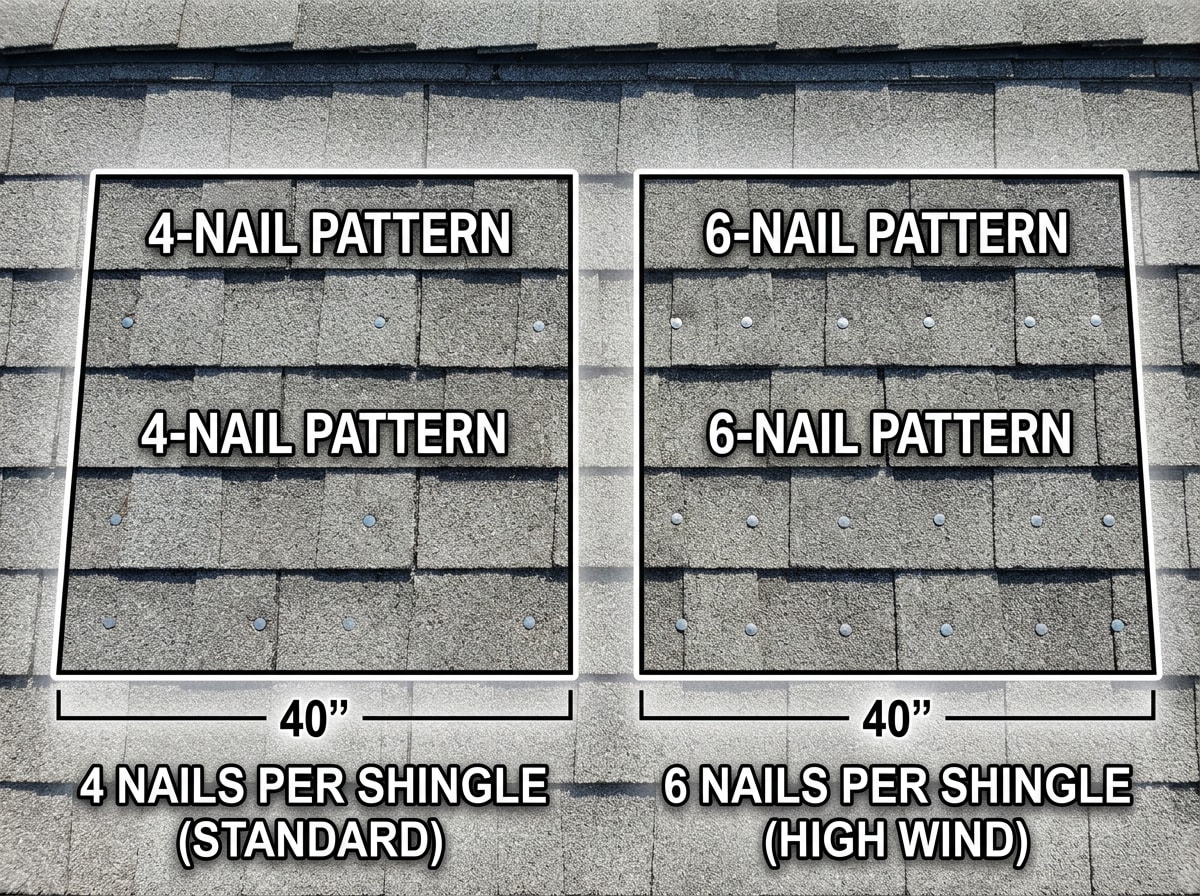
Before buying boxes, check the manufacturer's installation sheet. Following the posted fastening pattern is usually required to keep your shingle warranty valid, and it's one of the first things our crews verify on any roof installation we quote.
What Is a Roofing Square?
In roofing, a square refers to a unit of area that covers 100 square feet. Contractors and manufacturers use squares instead of raw square footage because it simplifies estimates and pricing across roofs of any shape or pitch.
When a shingle bundle says it covers a third of a square, that's a direct reference to this 100-square-foot benchmark. Understanding this unit is the first step to calculating nails, shingles, underlayment, and nearly every other material on your order sheet.
How to Calculate Roofing Nails Per Square
The math is straightforward once you know two numbers: shingles per square, and nails per shingle.
- Start with the shingles needed to cover one square.
- Multiply by the required fasteners per shingle.
- Example:
80 shingles × 4 fasteners = 320 nails, and 80 shingles × 6 fasteners = 480 nails.
For a full roof, scale that up. A typical 2,000-square-foot single-story roof runs about 20 squares, so at 320 nails per square that's roughly 6,400 nails for a standard install, or 9,600 for a 6-nail high-wind job. Do not assume every product uses 80 shingles per square , since bundle counts vary by manufacturer and shingle style.
Why Manufacturer Requirements Can Push Your Count Higher
This is the part most nail calculators skip, and it's where a lot of DIY orders come up short. Not every brand defaults to the simple 4-nail or 6-nail split.
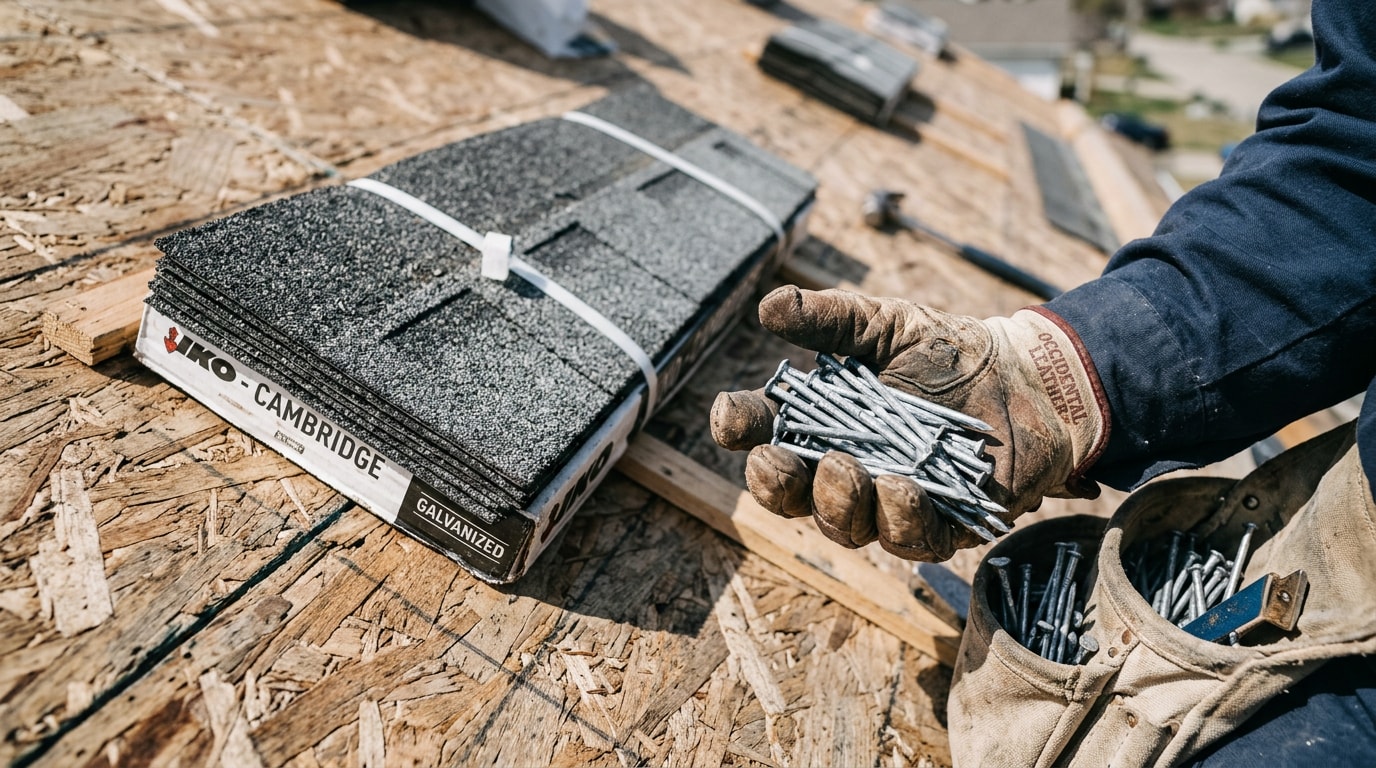
GAF's own asphalt shingle guidelines call for 4, 5, or 6 nails per shingle depending on the product line and local code, and most of GAF's shingle lines default to 6 nails regardless of wind zone. Run that pattern against a bundle that covers less ground than a standard 3-tab shingle and the per-square total climbs fast. One real-world breakdown shows an average of 506 roofing nails per square when using a manufacturer's recommended 6-nail-per-shingle strategy , because each shingle bundle contains about 28 shingles, working out to roughly 84 shingles per square rather than the 80 most people plan around.
On jobs we've priced across Longview and Vancouver, WA, this is exactly why two roofs that look identical from the curb can need noticeably different fastener counts. The shingle brand, not just the wind zone, decides the final number. If you're still choosing a product, our shingle buying guide breaks down how material choice affects installation requirements like this one.
Nail Count by Pattern and Shingle Type
| Pattern | Nails Per Shingle | Shingles Per Square | Nails Per Square | Typical Use Case |
|---|---|---|---|---|
| Standard application | 4 | ~80 | ~320 | Most residential roofs, moderate wind zones |
| High-wind / enhanced | 6 | ~80 | ~480 | Coastal regions, steep slopes, high-wind codes |
| Manufacturer-specific (e.g., some GAF lines) | 6 | ~84 | ~500-506 | Brand-specific product requirements |
Treat this table as a starting point. The product label on your bundle always overrides a general chart.
Roofing Nail Size, Material, and Code Requirements
Getting the count right matters, but size and material determine whether those nails actually hold for 20-plus years.
Fasteners for asphalt shingles shall be galvanized steel, stainless steel, aluminum, or copper roofing nails with a minimum 12-gauge shank and a minimum 3/8-inch-diameter head, complying with ASTM F1667. That's not a brand recommendation, it's the baseline in the International Residential Code, per the ICC's published roof assemblies chapter.
On fastener count specifically, asphalt shingles must have the minimum number of fasteners required by the manufacturer's approved installation instructions, but not less than four fasteners per strip shingle or two fasteners per individual shingle. Wind speed raises that floor. In wind zones greater than 110 mph, code allows special fastening methods of six nails per shingle or the manufacturer's specification , while wind zones under 110 mph only require the normal four-nail application or the manufacturer's specification.
Depth matters as much as count. For a standard asphalt shingle roof, roofing nails must penetrate a minimum of 3/4 inch into the roof sheathing. Thinner decking requires the nail to pass all the way through instead.
Smooth Shank vs. Ring Shank
Smooth shank nails are the most common and least expensive option, and they work fine with standard nail guns in mild climates with moderate wind exposure. They're just not the first recommendation in storm-prone regions.
Ring shank nails use a grooved shank that bites into the sheathing and resists backing out through seasonal expansion and contraction. Many manufacturer warranties in high-wind zones specifically require ring shank fasteners instead of smooth shank, so check your product documentation before buying.
How Many Nails Per Bundle and Per Box?
Once you know your pattern, the next question is packaging. Shingle bundles and nail boxes rarely line up neatly, which is how estimators end up short on job day.
- A standard 3-tab bundle covers about a third of a square, so three bundles complete one square.
- A box of 1-1/4" coil roofing nails typically holds
roughly 7,200 nails , enough for roughly 20 to 22 squares on a standard 4-nail job before accounting for waste.
- Switch to a 6-nail high-wind pattern and that same box covers closer to 13-15 squares.
- Add 10% to any order for bent nails, misfires, and starter-strip or ridge-cap fasteners that aren't part of the field count.
Nail Gun vs. Hammer
A pneumatic nailer installs shingles far faster than hand-hammering, which is why most professional crews use one. Most warranty-grade installs still require the full nail count in high-wind zones regardless of tool, since speed doesn't reduce the fastening requirement.
The real risk with pneumatic nailers is overdriving: setting the air pressure too high sinks the nail head through the shingle mat, which weakens holding power even though the nail count looks correct on paper. Framing and coil nail guns fire the largest nails and are the most powerful, and serious injury can occur even when they're working properly , according to OSHA's nail gun safety guidance. For larger or complex roofs, our roof installation team handles tool calibration and pattern compliance as standard practice, so overdriving and underdriving never become a callback.
Why Nail Placement Matters as Much as Nail Count
A roof can hit the technically correct nail total and still fail early if those nails land in the wrong spot. Placement, depth, and location inside the manufacturer's nailing zone matter just as much as reaching 320 or 480 nails per square.
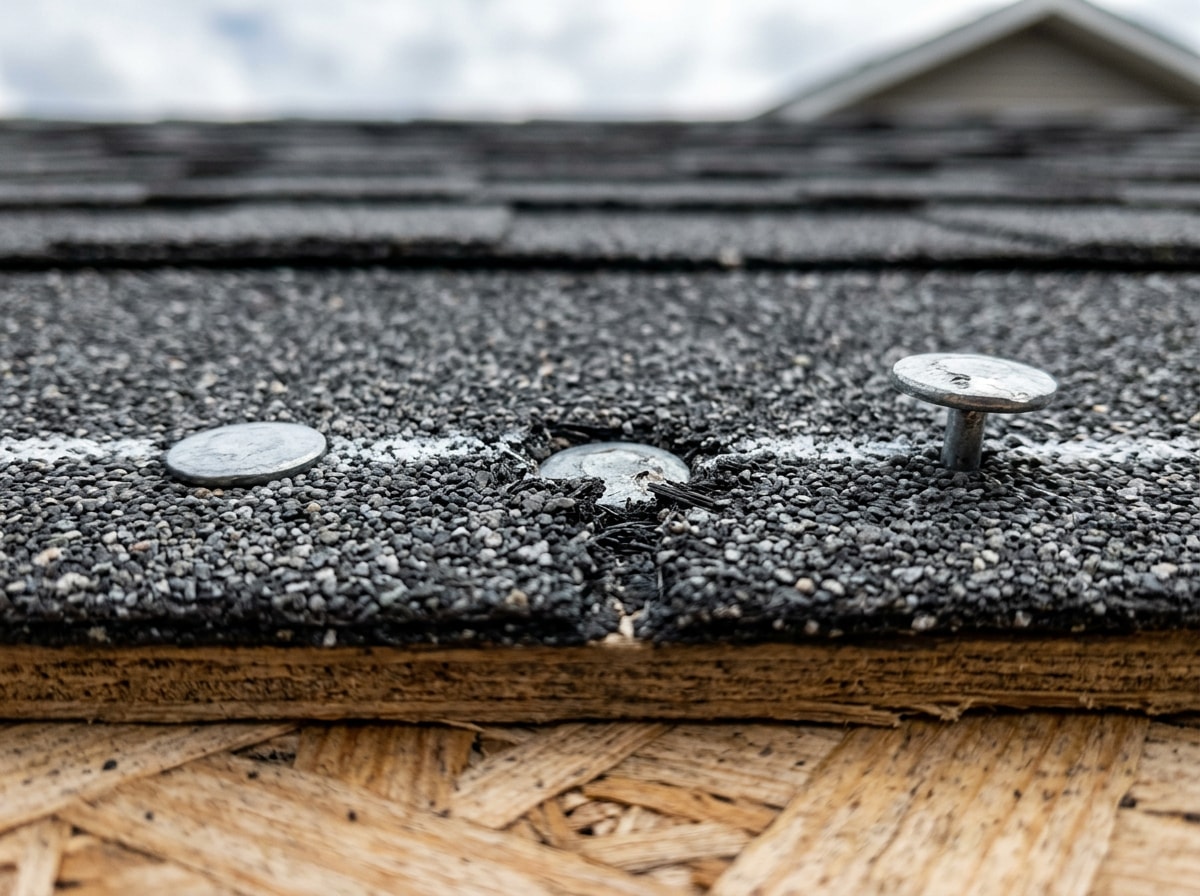
- Nail driven too high: Misses the double-layer reinforcement strip, reducing holding strength and often voiding the warranty.
- Overdriven nails: The head sinks through the shingle mat instead of sitting flush, cutting holding power and opening a path for water.
- Underdriven nails: The head sits proud of the surface, which can tear the shingle above it or catch wind and lift during storms.
- Angled or crooked nails: Reduced contact surface means they back out faster over time.
A state nail gun safety guide from Washington's Department of Labor & Industries covers safe tool handling for crews working on exactly these fastening patterns, which matters if you're tackling the install yourself.
Field Notes from Black Bear Home Exteriors
This guide was reviewed by Derek Hansen, lead roofing estimator at Black Bear Home Exteriors, who prices nail counts and material takeoffs on roofs across the Southwest Washington Metro area, including Longview and Vancouver, WA. In practice, the manufacturer spec sheet settles more disputes on a job site than any general rule of thumb, which is why our crews pull the product documentation before ordering a single box of nails.
If you'd rather skip the math and get a crew that already knows the local wind-zone requirements, request a free estimate and we'll handle the nail pattern, the material selection, and the install.
FAQ
How many roofing nails are in a square?
A standard 4-nail pattern comes out to roughly 320 roofing nails per square, while a high-wind 6-nail pattern runs closer to 480 nails per square for a typical 80-shingle square. Some manufacturer-specific patterns push that closer to 500, so always check the product label.
How many nails per shingle?
Most asphalt shingles require a minimum of 4 nails per shingle in standard wind areas, with 6 nails per shingle required where design wind speeds exceed 110 mph or where the manufacturer specifies it. Some premium shingle lines require 6 nails on every install, regardless of wind zone.
How long should roofing nails be?
Roofing nail length depends on your layers. Roofing nails must penetrate a minimum of 3/4 inch into the roof sheathing , and if the deck is thinner than that, the nail needs to pass all the way through. Thicker decks or re-roofs over existing layers typically need longer nails to hit that minimum.
How many shingles are in a bundle?
Most 3-tab bundles cover about a third of a square, which works out to roughly 26 to 29 shingles per bundle depending on the manufacturer. Some product lines run about 28 shingles per bundle, or roughly 84 shingles per square , so three bundles typically complete one square.
How many boxes of nails do I need per square?
A standard box of 1-1/4" coil roofing nails holds about 7,200 nails . At a 4-nail pattern that covers roughly 20 to 22 squares; at a 6-nail pattern, plan on closer to 13 to 15 squares per box, plus a 10% buffer for waste.
When do I need a 6-nail pattern instead of 4?
Code generally requires the 6-nail pattern in wind zones above 110 mph , but some manufacturers require it on every installation regardless of local wind speed. Check your shingle's printed instructions first; the product spec always overrides a general wind-zone rule.